
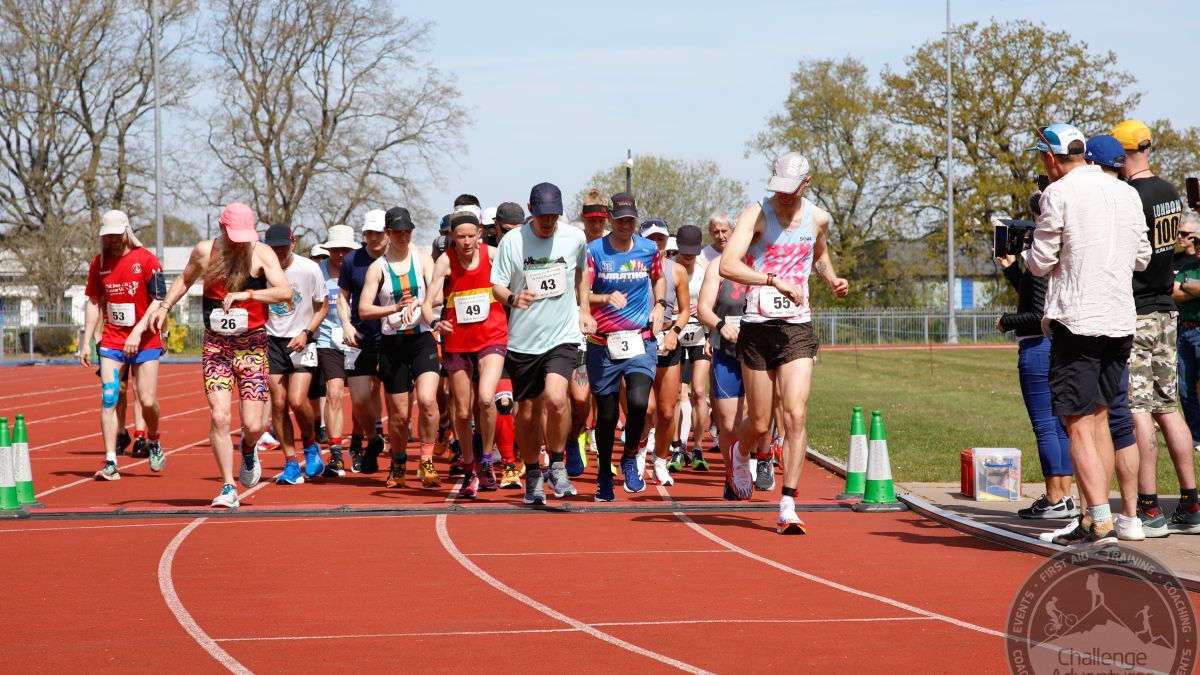
Crawley 24 Hour Track Race – the start
The sun was shining when I arrived at the track behind the Crawley K2 arena just before 9 a.m. on Saturday 12 April. I’d walked there from the hotel a mile away where I’d spent the night before the race. Volunteers were busy setting everything up. It was my second time volunteering at the Crawley A.I.M. Charity 24 Hour Track Race, having been there in 2023 (read my race report). In 2021 I’d competed in the 12-hour race which gave me a taste of the special challenge involved in running through the night. When I was volunteering in 2023, I’d had to have a nap in the early hours of the morning, would I manage to stay up all night this time?
From 10 a.m. the competitors arrived, picked up their numbers and pitched their tents at the far side of the track. I took photos of many of the competitors and asked them about their hopes for the race. Some were going for records, some for a qualifying standard to be considered for selection for the International Association of Ultrarunners (IAU) 24 Hour World Championship at Albi in France in October. Some wanted to get to 100km, others to 100 miles. Some wanted to improve on their performance in previous races and still be going round the track on Sunday morning. For those who had never done a track ultra before it was about finding out what it was like and what they could do. Whatever their goals were, to get through 24 hours, competitors were going to need grit, determination and luck. Who would still be on the track at midday on Sunday?
The 18 female and 30 male competitors gathered on the track for the pre-race briefing by Pam Storey, race director, and Hilary Walker, race referee, and posed for a start line photo. Then at midday they were off.
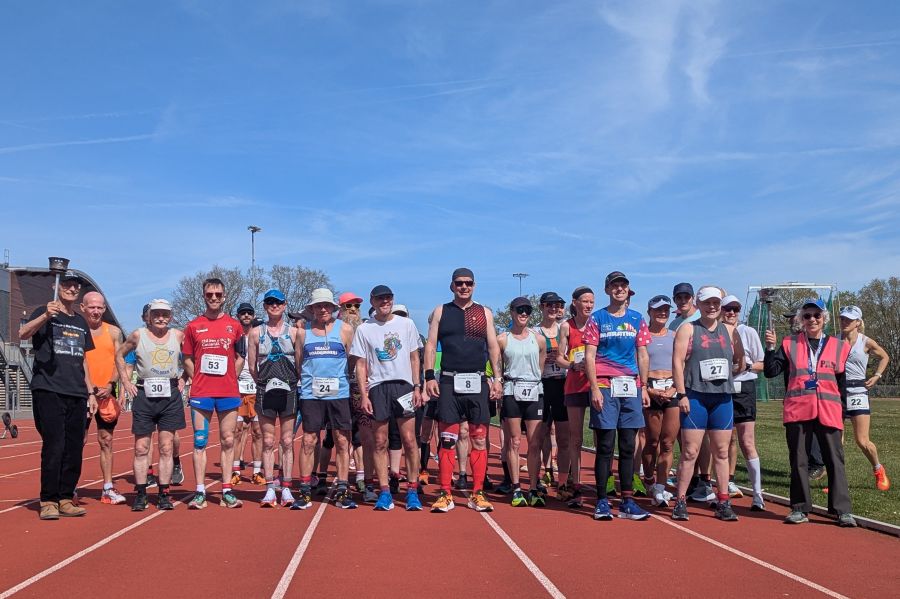
The first two hours
By 2 p.m., Sarah Webster had taken the lead in the women’s race and was in 4th place overall. She would not relinquish the lead for the remaining 22 hours. Although it was Sarah’s first 24-hour race, the Isle of Man athlete had already made her mark in ultrarunning. In March 2024, she had set a European 100km record and v40 world best of 7:03:48 at the Sri Chinmoy 100km at Perth, and in December 2024, she had represented Great Britain & Northern Ireland at the IAU World 100km Championship in Bengaluru, India, winning a bronze medal.
Meanwhile, Ben Carroll had moved into the lead in the men’s race and would remain in the top three men for the remainder of the race. Ben had set his 24-hour personal best at Crawley in 2023, when he’d finished second to Gareth Pritchard with 248.473km (154.39 miles). He’d also won the Crawley 6-hour race in 2022.
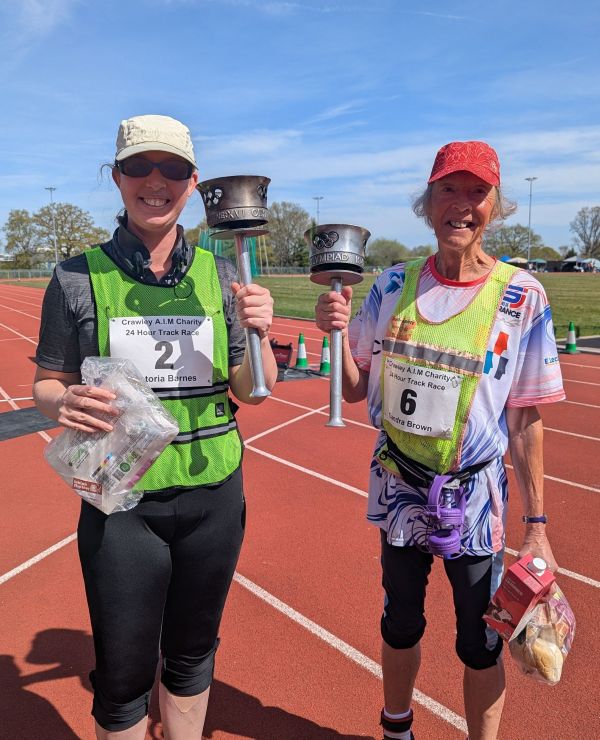
Victoria Barnes & Sandra Brown before the start, holding Olympic torches
3pm to 9pm
At 3pm Sarah was one lap behind Ben Carroll who was on 92 laps (36.8km). Alex Marshall and Sam Hudson Figueira, holder of the British 100 mile record, were second and third in the women’s race. Peter Windross, the 2019 winner, and Paul Maskell were now second and third in the men’s race.
I had prepared for the race by making a list of milestone distances and their equivalent in laps in my notebook so that we could let runners know that they’d reached a milestone when they crossed the timing mat. Pam Storey had asked me to write the race report for the Road Runners Club newsletter and I was recording voice notes during the race. After five hours, 36 runners had passed 25 miles (101 laps). Five of the top ten runners were women: Sarah Webster, Sam Hudson Figueira, Caroline Turner, Alex Marshall and Imogen Boddy. Ben Carroll, Paul Maskell and Michael Young were leading the men’s race. Just before 5pm Michael had noticeably increased his pace, running a lap in 1:28. He told us that he’d been struggling mentally and wanted to see if running faster would make himself feeling better. It seemed to do the trick. Alex Marshall retired from the race about half an hour later. She may still have been recovering from setting a new course record in the 200-mile Tunnel Ultra just five weeks before.
At 7 p.m. it was a bit cooler, dry and overcast. Some competitors had put on warmer clothes. Ben Carroll, Sarah Webster, Paul Maskell and Michael Young had all done 50 miles (202 laps). Michael told us he was “nearly enjoying it now”. An hour later, when the race changed direction for the second time, six more runners had also gone past 50 miles. Hot food and soup were served around this time. This was much appreciated by those competitors who didn’t have their own support crews and by the hungry volunteers.
The toughest hours
Around 9 p.m., the gap between Ben and Sarah was narrowing. Sarah’s laps were about ten seconds faster than Ben’s and at 9.17 p.m. she overtook him. Michael had been putting in some fast laps and at 10 p.m. he was in second place behind Sarah. Paul Maskell had retired on reaching 100km as he had sustained an injury during the race. Sam Hudson Figueira had also retired. The competitors now faced the toughest hours of the race. There were still many hours of darkness to get through. There were several rain showers between midnight and 4am. Fourteen competitors retired from the race between 9.30 p.m. and 4 a.m., including former race winners Peter Windross and Wendy Whearity. I managed to stay up for the whole night this time. With a few seconds left before midnight, Sandra Brown completed her 200th lap, setting a new v75 world age group 12-hour record of 80km, adding over 5km to the distance achieved by Janice O’Grady of the USA in 2023. Sandra’s pacing was very controlled over the whole race. For her first 50km nearly every lap was between 3:23 and 3:31. She slowed a little after that to laps of around 3:40 but then increased her pace from lap 191, in order to get 200 laps within 12 hours. She was steadily moving up the placings and was now 34th.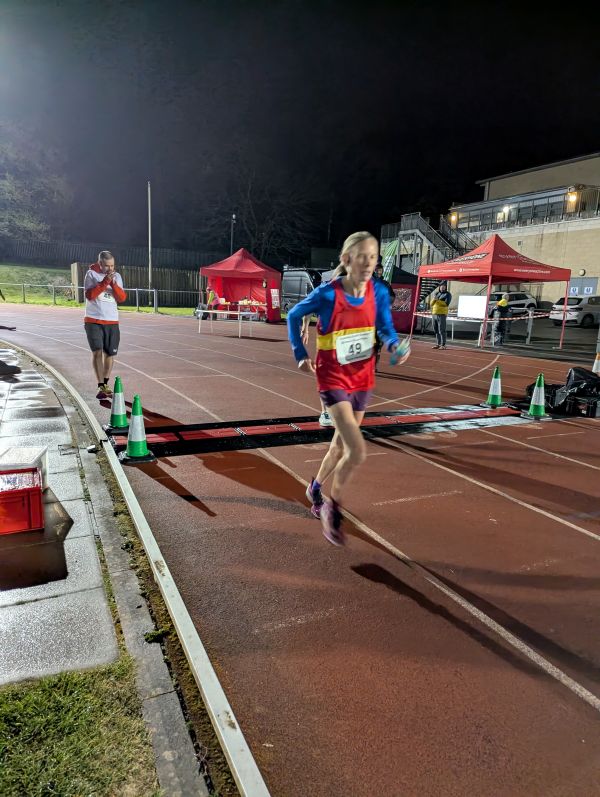
Shortly after Sarah Webster crossed the timing mat at 2:05 a.m., Hilary Walker, the race referee, confirmed that her time, 14:05:05, was a British record. It was over five minutes faster than the record Sam Hudson Figueira had set in 2022.
Sarah was more than 20 laps (8km) ahead of Michael Young. Ben Carroll was seven laps behind Michael and Ciaran McAneny had just moved into third place in the men’s race. Caroline Turner was second in the women’s race and Alice Mezincescu of Romania had moved up to third. At around 2.40 a.m. Caroline retired from the race, feeling too cold to carry on. Karen Nicol moved into third place in the women’s race. At 3.30 a.m. Ben reached 100 miles, having overtaken Michael who was two minutes behind him. Just after 3.30 a.m. Sandra Brown set another v75 world age group record. She reached 100km in 15:32:29, surpassing the record she had set in Spain three weeks earlier.
Sarah Webster setting the British 100-mile record
Daybreak and breakfast
At a quarter to six, dawn was beginning to break, streaks of pink cloud brightened the sky, the morning chorus was in full song. Sarah seemed to be going through a dip. She had stopped for a break at her tent, where her teenage daughter Penny was providing crewing support, and was sitting down. In an interview with Adrian Stott after the race, she said that her back had gone. She had started to feel cold, had put on thermal leggings and then got a quick massage at the first aid tent. After that she ran/walked in pain for nearly four hours. “I was absolutely determined even if I’d had to walk the rest of the way that I would finish,” she told him.
Shortly after 6 a.m., Michael Young retired, having completed just over 110 miles. 30 of the 48 starters were left in the race. Most were mixing running, jogging and walking. I helped to prepare the breakfast of porridge, toast and tea and we set it out on tables on the track at 7am.
At half past seven, Sarah was at 204km, with another 22km to go to reach the qualification distance to be considered for selection for the British team for the world championships. She was struggling. Would she make it? At one point, when the gap between them was only a few laps, I suggested to Ben Carroll that he might overtake Sarah, but he shook his head and said, “No, she’s got me”.
The last three hours
With three hours to go, at 9 a.m., there was another change in the men’s top three when Gordon Mead passed Ciaran McAneny, moving into second place. The top three overall were Sarah, 536 laps, Ben, 515 laps, and Alice, 478 laps. It felt as if the race was winding down as more than half the field was walking.
The morning was sunny but with a chilly breeze. The leisure centre café was open, and some of the support crews had fetched ice creams for their runners. I didn’t feel warm enough for that. At 9.30 a.m., Victoria Barnes was very pleased and relieved to reach 100km. At 10.10am, Alice Mezincescu celebrated reaching 500 laps, 200km. It seemed to be a turning point. Having suffered with sickness for several hours, she clearly felt much better. It was lovely to see how happy she was at achieving her 200km, and it wasn’t long before she asked me how many more laps she needed to get to 210km.
Sarah Webster’s remarkable recovery
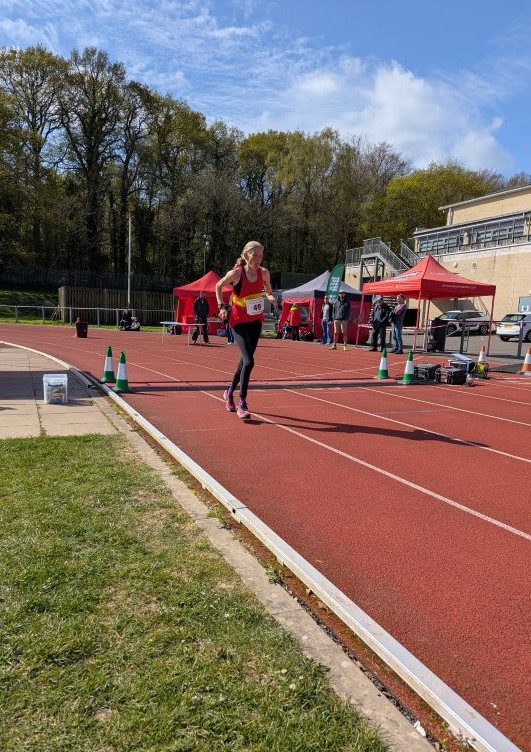
Sarah Webster near the end of the race
Meanwhile, Sarah had been walking for some time and looked spent, but, magically, as she approached 226km (the qualification mark for the world championships), she seemed to recover and started running again. She carried on powering round the track until the race ended at midday. It was exciting to watch. I started reckoning that Sarah was moving into, and then up, the British top ten rankings. While other competitors were slowing down, she was running fast (all bar one of Sarah’s last 27 laps were under two minutes). As my voice notes, from half an hour before the finish, attest: “She might be going to end up third or fourth on the all-time list which… suggests to me that she could set a record on another day if the situation’s right.”
My prediction turned out to be accurate later in the year. However, whereas I had been thinking of the British 24-hour record, it was the world record that Sarah broke. After the race, she and Paul Maskell were selected to run for Team GB & Northern Ireland at the IAU World 24 Hour Championships in Albi, France, on 18th–19th October 2025. Sarah won Gold and set a new world record: 278.621km, in a performance described by British Athletics as “one of the most outstanding ultra performances in British history.” The British women also secured the team title.
The finish and the awards
As the race finished at midday, twenty-five runners and walkers were still on the track, 10 women and 15 men. Sarah’s final distance, 243.393km, earned her third place in the British 24-hour all-time best list. She was the second woman to take the overall win in the eight-year history of the race – Wendy Whearity won overall in 2022. Alice Mezincescu finished second woman and third overall with 214.534km, an improvement of nearly 30km on the personal best she had set when she won the Gloucester 24 Hour track race in 2024. Karen Nicol was third with 182.8km in her first 24-hour track race. She was particularly pleased that this gave her a full set of Crawley podium places as she had won the 12-hour race in 2018 and the 6-hour race in 2019. Sandra Brown, as I’d predicted, had moved up the placings, finishing 21st with 138.684km.
In the men’s race Ben Caroll had determinedly held onto the lead, finishing with 225.793km. Gordon Mead was second with 206.265km, Ciaran McAneny was third with 201.311km. For Gordon and Ciaran, it was their first 24-hour race. Thirteen competitors had made it to 100 miles and a further 28 had made it to 100 kilometres.
Afterwards, once the results had been finalised and checked by Hilary Walker, the race referee, we made our way to an upstairs room in the leisure centre for pizza and the presentations. Matt Field, the British men’s 24-hour record holder, presented the medals and prizes. This year the race was hosting the UK 24 Hour Championship and the UK Athletics medals were awarded to:
Sarah Webster – Gold
Karen Nicol – Silver
Fiona Davies – Bronze
Ben Carroll – Gold
Gordon Mead – Silver
Ciaran McAneaney – Bronze
With thanks
This was Pam Storey’s last year organising the event. The Crawley A.I.M. track ultras were started by her in 2006 with 6-hour and 12-hour races. In 2017 the 24-hour format was added. 2025 marked the eighth 24-hour event. Over the past twenty years, the event has raised many thousands of pounds for a charity where Pam is a trustee, Advance International Ministries (A.I.M.). Through organising Crawley Pam has made an important contribution to keeping ultra distance track racing going in the UK. Dozens of people, including me, have run their first track ultra at Crawley. Thank you to Pam and all the officials and volunteers who make these events possible. Perhaps I will one day have a go at 24 hours. In the meantime, I can recommend volunteering as an excellent way to immerse yourself in the experience of a 24-hour race, to support others, and to witness extraordinary performances. And it’s fun!
Banner photograph courtesy of Lindley Chambers, Challenge Adventurers
All other photographs are copyright to me.


0 Comments