
British women’s marathon record – context
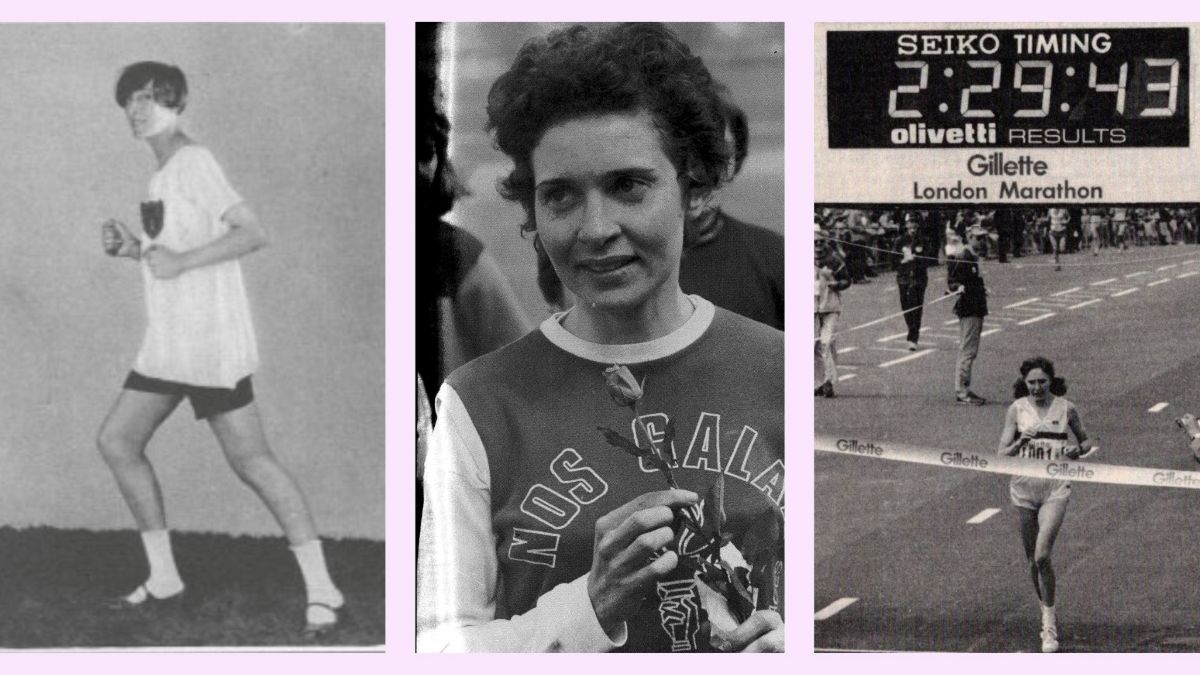
The British women’s marathon record progression begins with Violet Piercy’s time of 4:25 in an unofficial run in 1936. It ends with Paula Radcliffe’s 2:15:25 in 2003. For most of the twentieth century women were not permitted to run marathons. Victorian women were told they should avoid vigorous activity as it would endanger their fertility. These widely held views limited the development of women’s sport, particularly athletics, for decades.
The formal organisation of women’s athletics started in the 1920s with the formation in 1922 of the English Women’s Amateur Athletic Association. A Scottish WAAA followed in 1930. Violet Piercy ran her first, unofficial, long distance in the 1920s. In 1936, the organisers of the men’s Polytechnic Marathon permitted her to run the course, starting shortly before the men’s race. Piercy was an anomaly. At the time, the WAAA permitted women to race no further than a mile on the track. Cross country races were longer, usually up to 3 miles. Road races for women were not part of the WAAA programme.
The 1960s onwards
In the 1960s, a small number of women in several countries attempted to run marathons, often by joining in unofficially. Unusually, Dale Greig’s participation in the Isle of Wight Marathon was with the organisers’ agreement.
In the early 1970s, marathon running became more open to women, notably in the USA and West Germany. In 1972, the Boston Marathon admitted women officially for the first time. Change was slow to come in the UK. Women weren’t allowed to race further than 6000m (4 miles) and there were very few road races for women. Finally, in April 1975, the rules changed in the UK and women could at last race longer distances including the marathon. Joyce Smith was the preeminent female marathoner of the period, setting the British record five times. Read more about this in my book Rulebreakers and Ghost Runners: the British women who asserted their right to run.
Women’s athletics were not added to the Olympics programme until 1928, and distances for women were short (Olympics timeline). The 1500m was only added in 1972 and it took a lot of campaigning to get the women’s marathon added to the programme in 1984. Joyce Smith, Sarah Rowell and Priscilla Welch represented Great Britain in the inaugural women’s Olympic marathon.
The British women’s marathon record progression
4:30:00** – Violet Piercy – 13/06/1936 – Polytechnic Marathon, London
3:27:25** – Dale Greig – 23/05/1964 – Isle of Wight Marathon
3:07:47 – Margaret Thompson – 26/10/1975 – Korso Marathon, Helsinki, Finland
2:50:55 – Christine Readdy – 16/04/1976 – Feltham Ladies Marathon
2:50:54 – Rosemary Cox – 03/09/1978 – Rugby and Midland Counties Marathon
2:41:37 – Joyce Smith – 17/06/1979 – WAAA National Marathon Championships, Sandbach
2:41:03 – Gillian Adams – 09/09/1979 – Nike-OTC (Oregon Track Club) Marathon, Eugene, USA
2:36:27 – Joyce Smith – 22/09/1979 – Avon International Women’s Marathon, Waldniel, West Germany
2:33:32 – Joyce Smith – 22/06/1980 – Sandbach Marathon
2:30:27 – Joyce Smith – 16/11/1980 – Tokyo International Women’s Marathon, Japan
2:29:57 – Joyce Smith – 29/03/1981 – London Marathon
2:29:43 – Joyce Smith – 09/05/1982 – London Marathon
2:28:06 – Sarah Rowell – 21/04/1985 – London Marathon
2:28:04 – Veronique Marot – 20/10/1985 – Chicago Marathon, USA
2:26:51 – Priscilla Welch – 10/05/1987 – London Marathon
2:25:56 – Veronique Marot – 23/04/1989 – London Marathon
2:18:56 – Paula Radcliffe – 14/04/2002 – London Marathon
2:17:18** – Paula Radcliffe – 13/10/2002 – Chicago Marathon, USA
2:15:25** – Paula Radcliffe – 13/04/2003 – London Marathon
** Recognised as a world best/world record by World Athletics
On 19th October 1975, Anne Clarke ran 3:11:54 at the Masters and Maidens Marathon in Guildford. Her time was over 15 minutes faster than Dale Greig’s in 1964, however the marathon was not an official race and therefore Clarke’s time is omitted from this list. At the Feltham Ladies Marathon, Clarke finished fourth in 3:02:32, within the British record Margaret Thompson had set in Korso.
Discover the stories of the rulebreakers who ran unofficially in men’s races and the pioneers of women’s long distance running in Rulebreakers and Ghost Runners: the British women who asserted their right to run.
British women’s marathon rankings today
Mara Yamauchi‘s time of 2:23:12 set at the London Marathon in April 2009 makes her the 5th fastest British woman and the only veteran athlete in the top ten rankings – she was 35 at the time. The other eight women in the list have all run their fastest times since 2022: Calli Hauger-Thackery, Charlotte Purdue, Jess Piasecki, Rose Harvey, Abbie Donnelly, Natasha Williams, Eilish McColgan and Jessica Warner-Judd. There’s still a significant gap between Paula Radcliffe’s British record of 2:15:25 and Calli Hauger-Thackery’s 2:21:24 which she ran at the Berlin Marathon in September 2024.
Sources
Association of Road Racing Statisticians
The Guinness Book of the Marathon, Roger Gynn, 1984
British rankings, power of 10 (requires login)
Progression of World Athletics Records, World Athletics, 2024
Rulebreakers and Ghost Runners: the British women who asserted their right to run, Katie Holmes, Bloomsbury Sport, 2026
Photos
Violet Piercy, The Sketch, 13/10/1926
Christine Readdy after winning the Feltham Ladies Marathon in 1976, Stride Out magazine, 1979
Joyce Smith crossing the tape at the 1982 London Marathon, Athletics Weekly, 22nd May 1982
0 Comments